Monday Jan 23, 2024
This is one of a five part series of a visit to Mekelle, Tigray and Addis Ababa in January 2024. Below are links to the series, or you can just follow the “next” and “previous” links at the bottom. You can send a message to the author here.
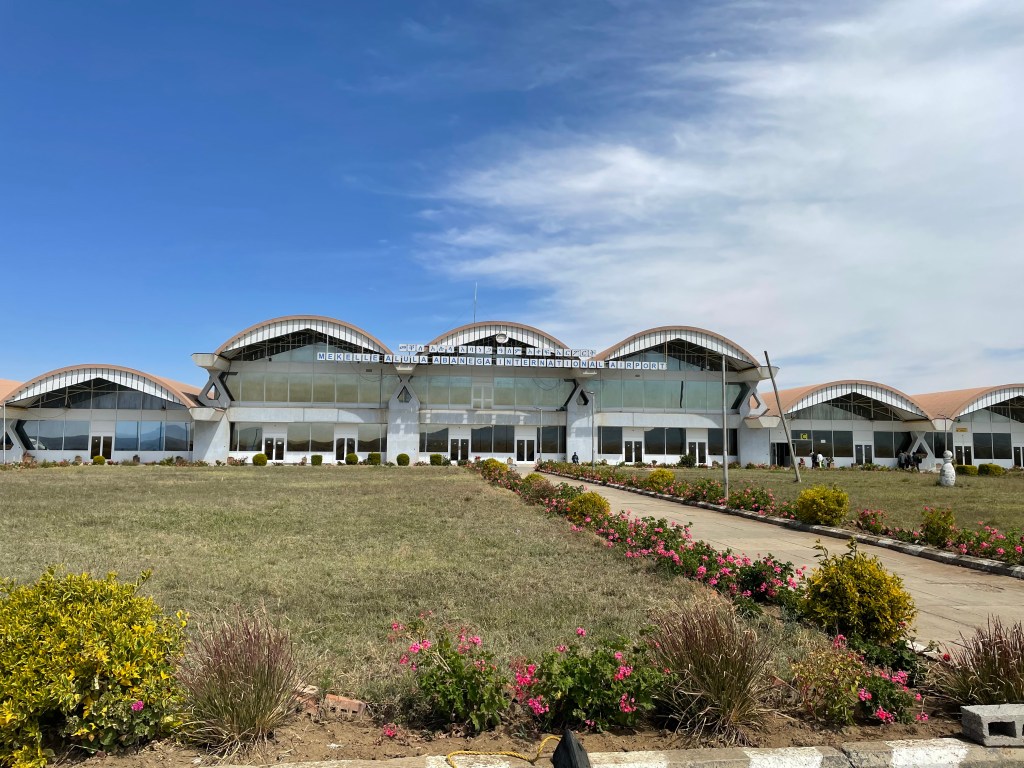
Dr Getahun met us at the airport with a driver and a pick up truck and took us to our hotel. On the way, he shared some his recollections from during the war period, i.e. until a year ago. It was obvious that it was very painful. There were only 5 orthopedic surgeons. The inflow of patients was massive and non stop. They had very little to offer the patients, which was very difficult. All they could do was focus on keeping the patient and the limb alive until they could be back later and do something to fix them.
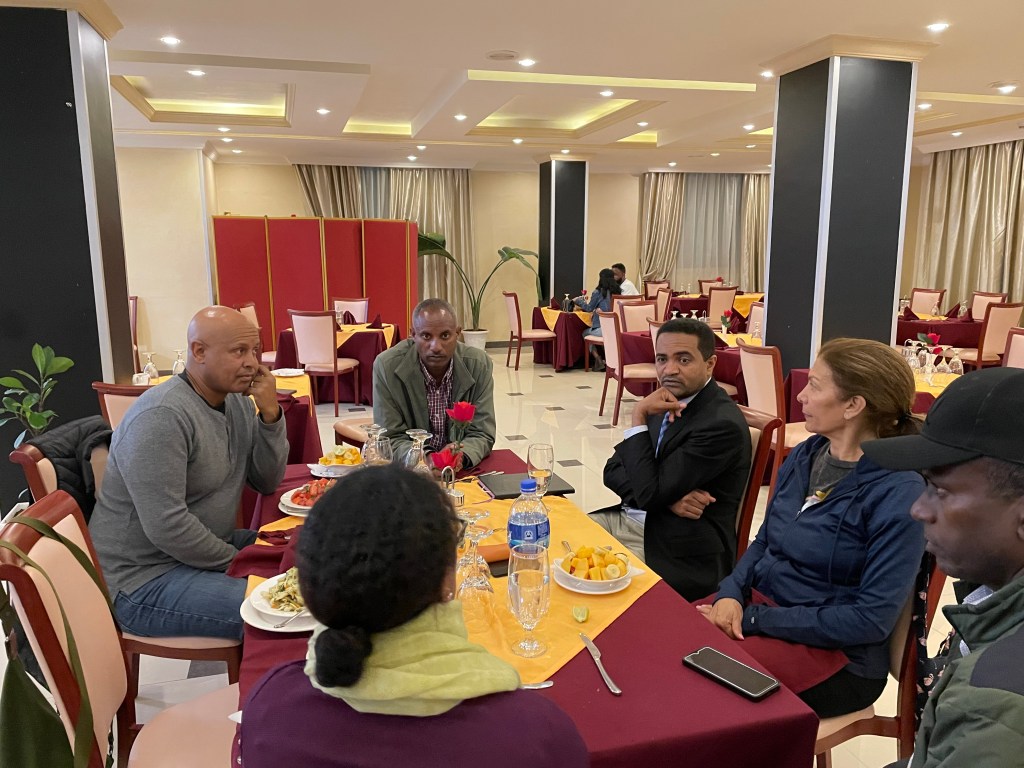
A little later, we went out for lunch at Gebre Selassie restaurant with Hagos, followed by tea at Abrha Castle hotel. Hagos is from Adigrat andYasmina’s cousin, one of our friends who was traveling with us. He is also a lecturer in Sociology at Adigrat University, and also seems to know everybody in Tigray. While we were eating dinner in our hotel, Dr Amanuel Haile came to see us. He is the current leader of Tigray Regional Health Bureau and was previously CEO of Ayder hospital (succeeding Dr Zerihun)
He is a very impressive man. He recited innumerable health statistics with ease, like the types of surgeries performed, the current back log, their issues with nursing education, the needs of rural health clinics, etc. He reminded me of Dr Zerihun, a striking combination of personal humility, deep conviction, vision and intellect. According to Hagos, he resisted the job of leading Tigray health bureau but Zerihun convinced him.
With work, they have been able to cut down the backlog of orthopedic surgeries from 15,000 to 9,000 over the last six months. Many of those still waiting are in the military facility nearby. They are frustrated that they have not gotten care but the reality is that every day new patients come in with acute traumas, displacing those with chronic injuries. At least the number of orthopedic surgeons has increased. They used to have 5-6 orthopedic surgeons but now have ~15.
There is a large number of patients with bone deformities, chronic osteomyelitis and destruction of joints which are very challenging to take care of. The deformity cases often take 2 surgeons. Many patients need arthroplasty which is not available at Ayder, some patients they referred to Addis but most likely do not have the resources and remain untreated.
Before the war, Ayder had a 3 Tesla MRI. It was a such a high quality machine, that he said when he showed it to Dr Tony the neurosurgeon, Dr Tony said with that he can work at Ayder and stayed in Tigray for several years, training many neurosurgeons. Dr Tony was very outspoken in the early days of the conflict and is worried for his safety if he tries to return to Ethiopia, so he remains outside. During the war, the supply of electricity to the MRI was cut off, which drained the helium cooling system. The magnet is not functioning but it may be able to be serviced. Ayder has a CT scan which is also not functioning right now but is getting serviced.
Dr Amanuel coming to see us in person was unexpected and a show of respect, that to me at least, is not yet earned. He said he wanted to express thanks in person for the donation of equipment. He stayed a long time with us, even though he was supposed to be home with his family. We covered a lot of ground. As expected, the sheer volume of needs and the scarcity of resources were important topics. But when I asked him what he thought were his highest priorities, his answer was initially a bit surprising. It was all about developing people.
He first talked about how the current surgeons need mentorship and teaching. They are good technically, but they need continued practice and improvement. Outside teaching is very helpful. He is also concerned that physicians maintain an attitude of respect and compassion (my words) towards the patient, even while the volume is heavy. For this, role modeling is iImportant. Before the war, there used to be groups of orthopedic surgeons from abroad, such as Germany and US, that would come for a period of time. I am the first Ethiopian orthopedic surgeon to come.
His biggest goal though is to identify and build leaders. These are the leaders who would not only have a good understanding of international standards but also a good understanding of the local situation. They would then recruit the resources needed to bring up those standards. He was confident that despite the destruction of the health care system, it will recover and return to being a role model in the country.
 Ethiopian Diaspora Surgery Network