AaBET Hospital
On my second day I visited AaBET hospital, which is part of St Paul University and located just behind Yohannes church, a short distance from the main St Paul campus in Gulele. The initials stand for “Addis Ababa Burns, Emergency and Trauma”.
As the main trauma hospital in Addis Ababa, it is overflowing with orthopedic injuries. In fact orthopedics is about 70% of its volume. I met with Dr. Wegagen chief of orthopedics and Dr. Mamo Deksisa, who was my guide for the day. As with just about all the surgeons I met, Dr. Mamo is very young by our standards for a staff physician with significant responsibilities – but clearly also very capable.
My first stop was morning conference where I gave an hour long lecture on bone and soft tissue tumors. Following this, Drs Mamo, Wegagen and I sat in the call room and talked for some time about the department, their needs and ideas about how can collaborate. Dr Mamo was extremely generous with his time and gave me tour of hospital as well as taking me to main St Paul campus where we tried to meet with Dr. Wondemagegn, the provost (CEO). Unfortunately, his waiting room was packed so we left and toured the grounds. Most of this is now a massive construction site where large buildings are are going up, planned for cardiology, gastroenterology, women’s health and oncology. We saw the undergraduate medical school buildings where Dr Mamo had attended and then we had a very tasty injera meal at his favorite lunch place near AaBET hospital. Remember in Ethiopia, as in many countries, students go directly from secondary school to medical school.
Luckily, it was his day off so we continued our tour. We went back to AaBET to catch up with Dr. Rick Hodes, an American pediatrician who has been in Ethiopia for many years. He has an unusual practice, funded by American donations. He initially concentrated on pediatric cancers, which he treated with chemotherapy but he is now almost exclusively dedicated to pediatric spinal deformities. He gave me a quick slide presentation of some of the dramatic spinal deformities he has treated. Many of those who are surgical candidates are sent to Ghana where the well-known Dr. Boachie performs near miraculous surgical corrections. Some were referred to Dr. Addisu, who performed some of the deformity spine surgeries during his January visit. If you are interested, you should visit Dr. Hodes’s website. It is quite something.
TAPPCO
We then went to visit TAPPCO (Tesfa Addis Parents Childhood Cancer Organization), an NGO dedicated to supporting the families of children undergoing chemotherapy. The visit was was very moving. Parents (and sometimes siblings) stay and eat at no charge while their children are treated . 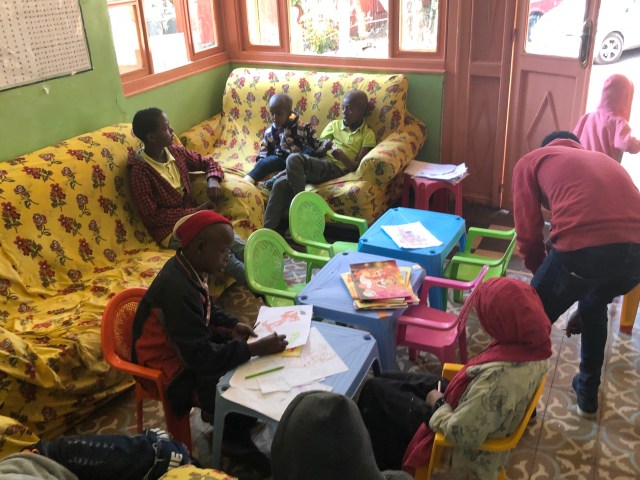
As they often come from far distances, many families would not be able to complete therapy nor return for follow up visits without a place to stay. This means many children would otherwise die. 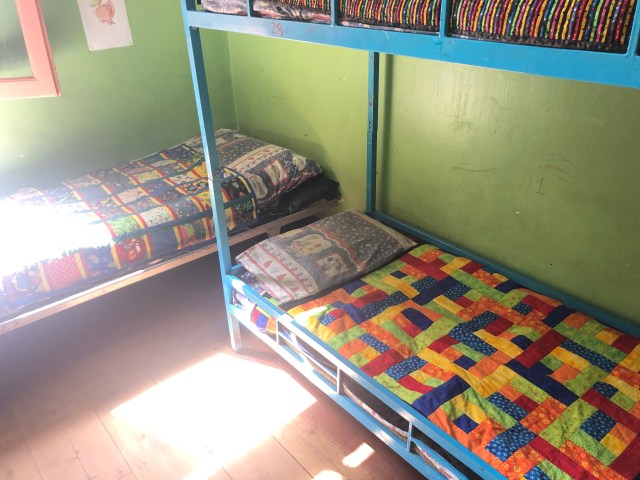
We learned that house, and food are supplied by the Mother Theresa foundation while the Aslan Project, an American organization, supports staff and pays for childrens’ outpatient medications. The latter is TAPPCO’s biggest challenge as these necessary cancer medications, normally provided at no charge by the government, are sometimes locked up by private pharmacies which sell them at massive markups.
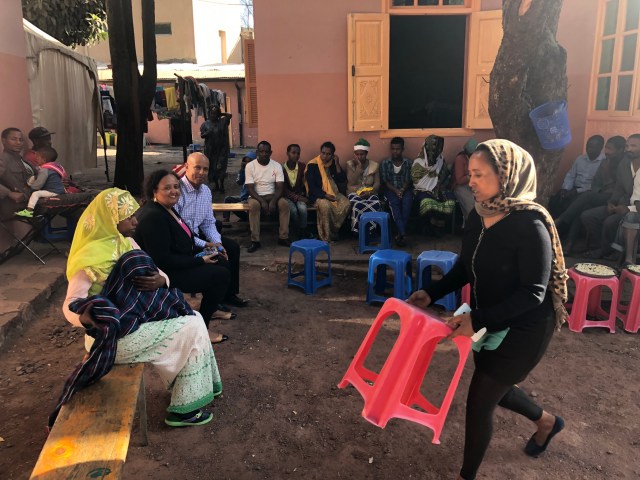
As we were readying to leave, we were asked to stay a little longer for the afternoon coffee ceremony. The parents gathered in a circle, coffee and popcorn were passed around. My family financially supports TAPPCO and Sara Ibrahim, the director, made this known to the gathering. On this, two parents took turns to stand and make long speeches expressing their gratitude. Despite knowing how vast the need is and how little of it we are defraying, this was very touching.
Mother Theresa
Finally we visited the Mother Theresa compound in Sidist Kilo, where patients can stay for free while awaiting hospital care or after hospital discharge.
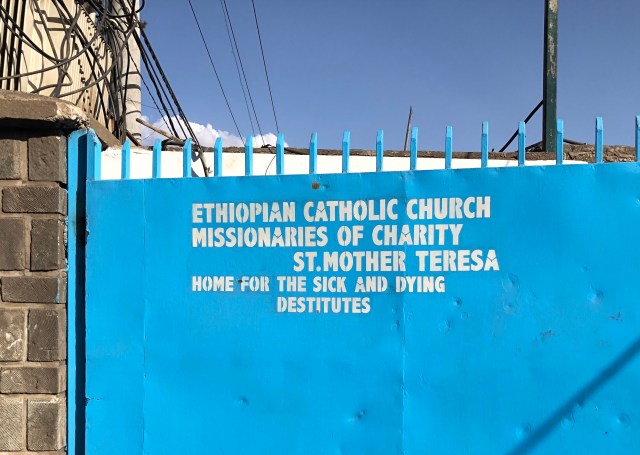
The compound also houses purely medical patients, such as those with tuberculosis or liver diseases, where they are cared for by three general practioners (GPs). A health officer gave us a tour of the very large compound which had several buildings. It was very impressive. The wards were spartan but clean. Those patients not confined to their beds were outside playing cards or chatting.
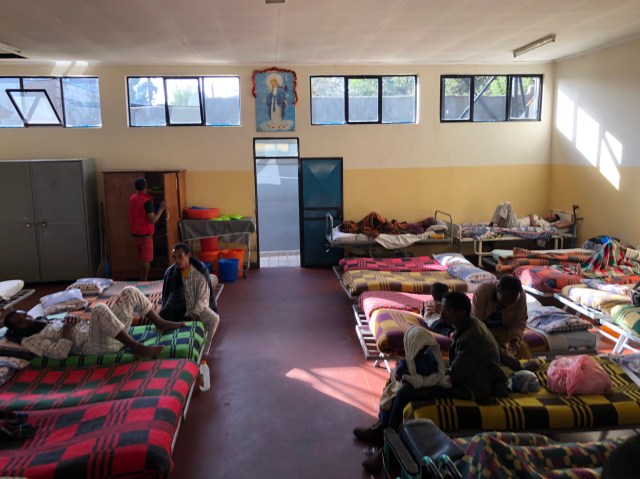
We saw two patients with bone tumors we had heard were there. As is common, both had presented very late. One was an 18y girl with a massively enlarged knee. She told us it had enlarged over a year and she is now unable to walk on it. She recently had an open biopsy at Tikur Anbessa. However, pathology results can take up to a month to return so, in the meantime, she is waiting at Mother Theresa. If confirmed osteosarcoma, her only surgical option is amputation. She will likely be referred for chemotherapy after surgery. Unfortunately, this also may be a month or more delay, due to limited availability.
The other girl, 14 years old, had undergone a very high transfemoral amputation 1 1/2 weeks ago. When we arrived, she was holding a bed post, attempting to stand. She was being encouraged by a Danish physiatrist, who like the other non-Ethiopians was likely a nun. Despite being under two weeks from surgery, she was incredibly stoic. Unfortunately, she had no hamstring or adductor attachments, which resulted in a nearly fixed 90 deg flexion contracture of her short residual limb. Even if this was fixed with a iliopsoas tenotomy, she would remain unlikely to be a good candidate for prosthetic fitting. If she survives, she will likely become independent with crutches and one leg.
ESOT
The Ethiopian Society of Orthopedics and Traumatology (ESOT) holds its annual conference around July in Addis. Nearly every Ethiopian orthopedist is a member and the event is well attended. Dr. Mamo the executive president and Dr Geletaw of Tikur Anbessa is the current president. For any Ethiopian Diaspora orthopedic surgeons attending this gathering and giving a lecture, perhaps as part of a family vacation, would be a terrific opportunity to share knowledge and make connections with Ethiopian orthopedic surgeons.
posted by Felasfa Wodajo
 Ethiopian Diaspora Surgery Network