Trauma Surgery
Dr. Geletaw and Dr Samuel completed 1 year fellowships in Toronto in pelvic and acetabulum trauma surgery and hip arthroplasty, following their residency at the Tikur Anbessa. As expected, the massive volume of trauma, especially motor vehicle and pedestrian accidents, prioritized trauma training.
Using their training as a springboard, Tikur Anbessa launched an orthopedic trauma fellowship. The first two fellows are now enrolled. This appears to be a recurring theme. When a fellowship trained surgeon is available, a fellowship training program is launched as quickly as feasible to expand the number of specialists. The hunger for additional training was noticeable everywhere during my visit. The immense needs of the country are palpably close.
Other fellowship trained physicians in Addis include Dr. Nardos, who completed a orthopedic pediatric fellowship in India and is serving on staff at Sr. Paul AaBET hospital. Another Tikur Anbessa resident is now in India doing a pediatric orthopedic fellowship. Dr Ermias, a Tikur Anbessa resident, is heading soon to Glasgow for a two year fellowship in orthopedic oncology.
Dr. Melesse, Sports Orthopedics
Another Tikur Anbessa resident, Dr Melesse, has been accepted to a well regarded sports fellowship in Tel Aviv, Israel. Unfortunately the position is unpaid. This means he cannot go unless he can raise funds for his stay in Israel. He estimates the cost for room and board would be around $1,100/month or ~$12k for the year. With transportation, we estimated his total cost to be ~ $15k USD. 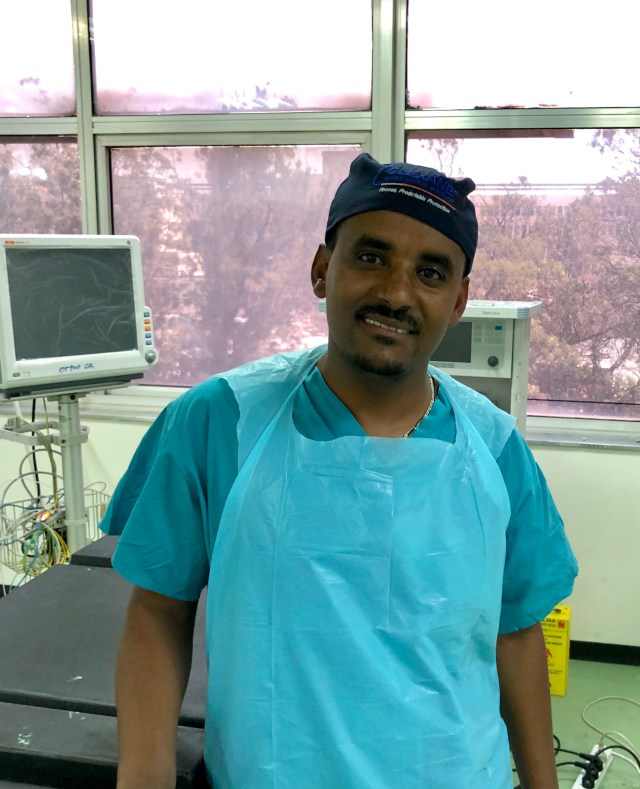
If he succeeds, he will be the first fellowship trained Ethiopian sports orthopedic surgeon in the country, which is simultaneously shocking and inspiring. Once he completes his fellowship, he will return and train the next round of Ethiopian Sports orthopedic surgeons. An arthroscopy tower has already been ordered for the hospital. I am now recruiting my fellow diaspora orthopedic surgeons to raise funds to ensure the success of Dr. Melesse. If you are interested, please use the Contact page on this site. This should be doable ! Donations will be tax-deductible through the Ethio-American Doctors Fund (EADF).
International Partnerships
The international fellowships I heard about were made possible through partnerships. The pediatrics fellowships in India were made possible by an American Christian group located in India. Oncology training in Glasgow was made possible by Dr. Sanjay, a UK trained surgeon of Indian origin who came to Ethiopia and made a connection with Dr Ermias. These seemingly haphazard opportunities demonstrate the potential for a national level impact one organization or even one individual can make.
Domestic Fellowships
By partnering with training programs in Northern countries, the impact of domestic Ethiopian training programs can be multiplied. A memorandum of understanding (MOU) has been signed with Kansas University (KU) to start a trauma fellowship at AaBET. KU surgeons assisted with developing the curriculum and will take turns visiting AaBET to help train fellows. I understand there is also discussion of starting a spine surgery fellowship program in partnership with Dr. Addisu Mesfin of Rochester University.
In the Ethiopian model, fellowship accreditation is via initial curriculum review only, and does not involve ongoing site visits and audits. The review is performed in two stages. The first is by peer programs in the same institution. After incorporating their feedback, the curriculum is sent to an outside reviewer at St Paul University.
In addition to the greater chance of sustainability that comes with basing fellowship programs in Ethiopia, the fellows will almost certainly get more surgical experience working domestically. One resident shared that fellows in India are not allowed to work independently. In the US, strict rules that require state licensing make it very difficult for foreign residency graduates to access hands on surgical experience. In contrast, Dr. Geletaw shared that he was given a high level of independence and encouragement in Toronto.
My impression is that a hybrid domestic fellowship program could be ideal. This would be formed in partnership with a Northern training program, whose teaching staff would rotate through Ethiopia. This way, Ethiopian surgeons can learn advanced surgical techniques within the Ethiopian context – while benefiting from the training and experience of North American and European surgeons. A hybrid program could also incorporate foreign observerships. These would allow Ethiopian surgeons to see how a northern health care system functions, especially the multilayered staff components, conventions and culture required to deliver consistently safe and high quality surgical care.
ACS-COSECSA Program in Hawassa
The American College of Surgeons (ACS) has partnered with the College of Surgeons of East, Central and South Africa (COSECSA) to create a novel and very intriguing model for two way North-South exchange of surgery training. This will involve American attendings and residents committing to monthly blocks in Hawassa so that an entire year is covered. This program will be discussed in more detail in a later post.
posted by Felasfa Wodajo
 Ethiopian Diaspora Surgery Network