During a one week stay in Addis, I visited three hospitals and met health care NGOs and Ministry of Health officials. The goal of this trip was to discover avenues where diaspora orthopedic surgeons can provide durable support for Ethiopian orthopedics. In my job, I work as an Orthopedic Oncologist in Fairfax, Virginia.
Resident Report
The first day was dedicated to Tikur Anbessa (Black Lion) hospital. The day started with morning report. A series of residents gave brief power point presentations of the weekend’s admissions and surgeries. Several staff members were present, including the chair Dr. Biruk. 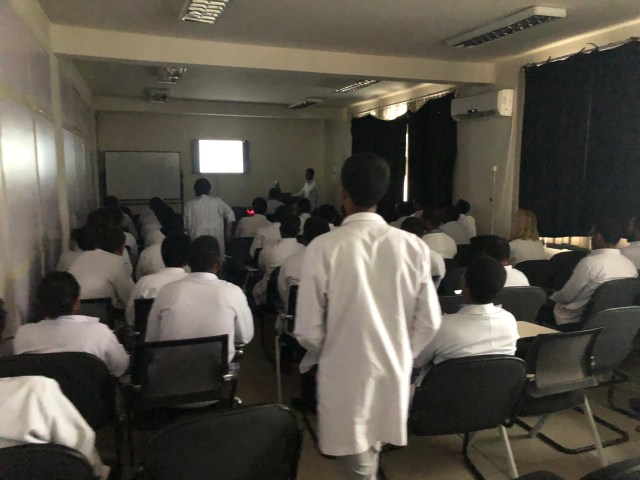
Residents provided well articulated descriptions of patient histories, physical exams and X-ray findings. They were asked questions about radiographic findings and fracture patterns, which they handled skillfully. Their presentations would be at home in any US hospital orthopedic morning report.
Contributions by non-Ethopian Surgeons and Groups
After morning report we went to the OR manager’s office, which doubles as the break room and spent a few minutes sipping coffee and chatting with department members. Dr Biruk told me many outside groups come to visit Black Lion, for example just in March five different groups are coming.
Johns Hopkins annually sends a large team of orthopedic surgeons from multiple subspecialities. Dr. Alexis is an orthopedic surgeon from the Seattle area who has come annually for the last 4-5 years and stays for up to 4 weeks. He performs arthroplasty, sports and spine surgery, and works with residents on trauma cases, sometimes into night. He leaves behind instruments and implants. In fact I discovered a basically complete set of Zimmer-Biomet hip instruments including head trials, acetabular and femoral reamers and broaches. There was a locked closet full of Zimmer-Biomet hip implants, complete with stems, shells, liners and acetabular screws, all of which he left behind. 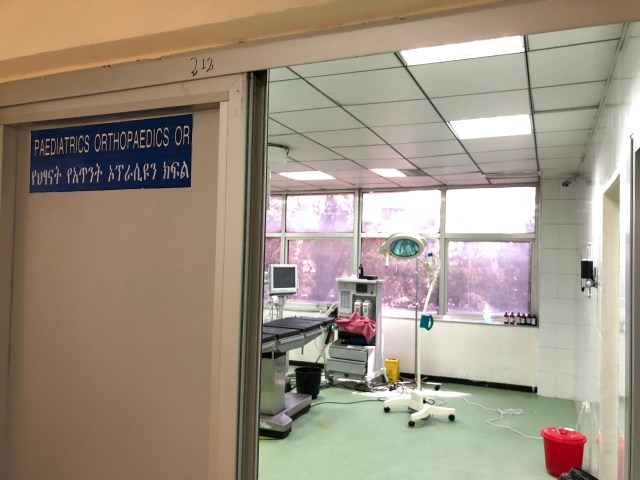
The Australian Doctors for Africa (ADFA) has been major long term supporter. They built four operating rooms in an existing rehabilitation building, which allowed for a major expansion for orthopedics, which previously only had one room in the main hospital. In addition to this capital donation, ADFA has given other equipment, including air conditioners for the ORs. The AO foundation in Africa, jointly with ADFA, supports yearly training sessions. These include basic and pre-basic training for residents, e.g. saw bones, and training for orthopedic operating room nurses, which has significantly improved capacity.
Pelvic & Acetabulum Trauma
After our coffee break, I followed Dr. Geletaw Tessema into the operating room where he performed open reduction and internal fixation of a 2 week old open book pelvic fracture. He and the trauma fellow first exposed the symphysis pubis and, with a large pelvic clamp, attempted to reduce it. However, the fracture was too old. So, through a separate incision he exposed the left ilium at the sacroiliac joint to take down the early callus. The symphysis was then reduced and plated followed by the left ilium. 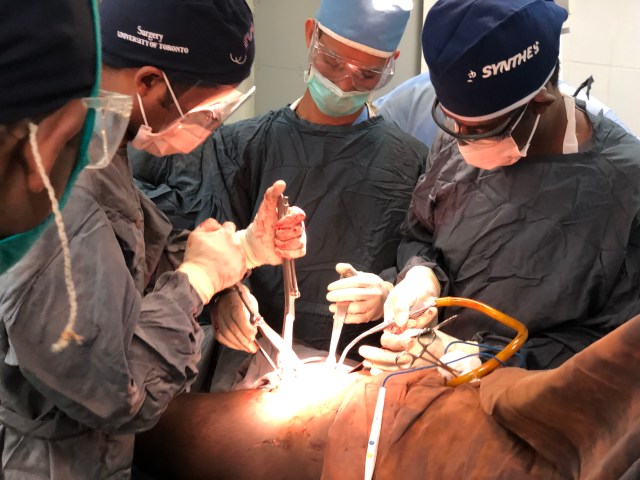
The country refers all acetabulum and pelvic fractures to Black Lion. As would be expected, there is often a long delay to surgery making fracture reduction more difficult and bloodier. Little major pelvic trauma arrives however, as patients probably do not survive long enough for transport. The one c-arm at Tikur Anbessa has stopped working, so all reductions have to be done open, which increases blood loss and heterotopic ossification. 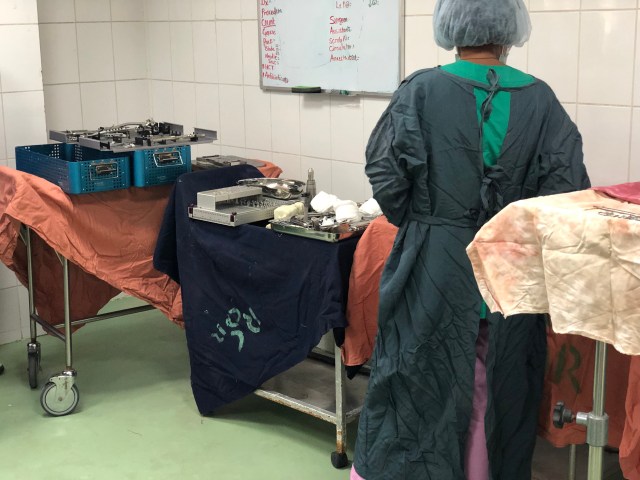
On a positive note, unlike in the past the hospital now has a regular and ample supply of screws and plates, largely imported from India. However, specialty trauma implants, like quadrilateral plates for the medial acetabulum, are not available.
Growing Pains
From two medical schools a couple of decades ago, there are now forty medical schools in the country. I was told by another physician that the catch word was not “expansion” but “massivization”. The impetus is obvious but the growing pains are also predictable. For example, I am told that graduating medical students are no longer guaranteed jobs by the Health Ministry. Instead, they are told to seek work in the public sector. While this would seem reasonable from a Northern perspective, the private sector has not built up that capacity either.
There are now four orthopedic residency programs in the country – Tikur Anbessa and St Paul in Addis, programs in Bahir Dar and in Mekele. Most of these are new, with the oldest at Tikur Anbessa only ~15 years old. Due to the manpower deficits in the country these programs have rapidly expanded, with Tikur Anbessa now training 25 residents per class, i.e. a total of 100 residents. While residents’ knowledge and intelligence are quickly apparent, an ongoing challenge is exposure to surgery and the availability of teaching faculty.
Anesthesia
The majority of orthopedic procedures are performed with spinal anesthesia, usually done by anesthetists. There are very few anesthesiologists available. During the procedure I watched, the spinal block was incomplete in the pelvic region with the patient expressing pain. This was controlled with a propofol drip, the patient was not incubated. I was told that regional blocks (e.g. sciatic/femoral/interscalene) are not performed. 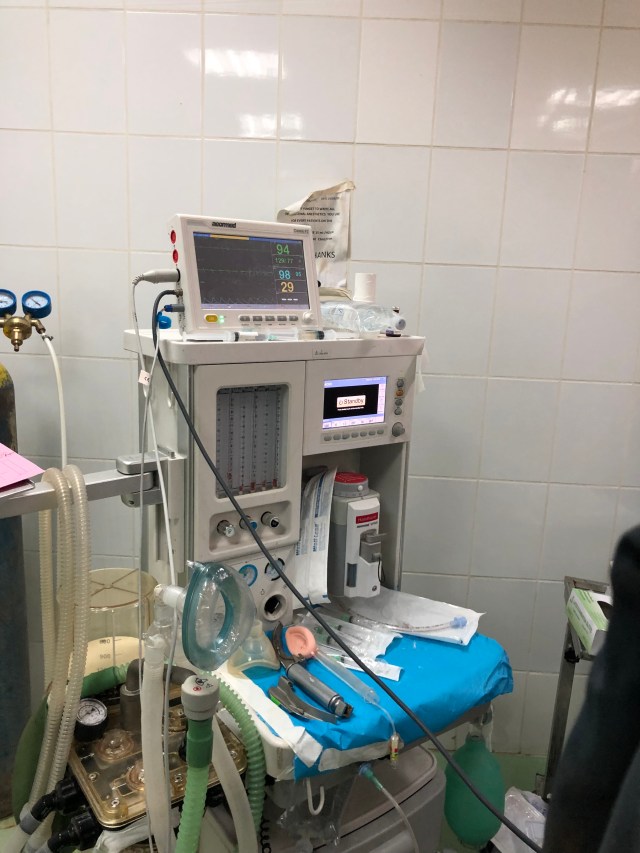
I did not ask at Black Lion but I was told there are ultrasound machines available at AaBET.
Arthroplasty and Equipment
At Tikur Anbessa, there are two arthroplasty trained surgeons, Drs Samuel and Geletaw. Their Toronto fellowship included hip arthroplasty along with pelvic/acetabular trauma. There is a working Stryker 5 set, in addition to which they have available household (Bosch) battery powered drills, which are covered with hand-sown sterile covers in the field. There are two working autoclaves which can fit two large trays. As mentioned above, there are available arthroplasty instruments and implants. 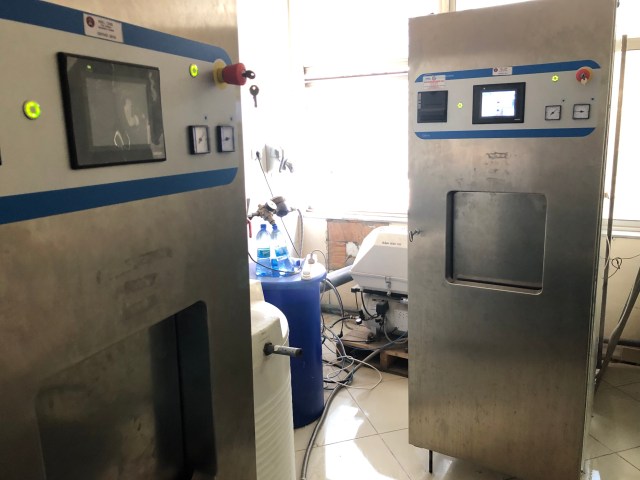
Despite this, no elective arthroplasty is being performed. According to the OR manager, there is a waiting list of over 500 patients. The bottleneck is time. Too much acetabular trauma comes in for surgeons to take on elective hip arthroplasty. At this time, there are no surgeons trained in knee arthroplasty at Black Lion (or AaBET), nor are there knee arthroplasty instruments and implants. Patients can go to private hospitals and surgical centers, some of which can and do perform arthroplasty, but at an out of pocket cost of ~160-200,000 Birr ($7K USD) which of course rules it out for the vast majority of the population.
posted by Felasfa Wodajo
 Ethiopian Diaspora Surgery Network